
8 June 2026
Report III: Surviving Gaza: access to essential services, humanitarian assistance, displacement, public priorities after the ceasefire, reconstruction needs, and emigration
Yet, despite the hardships, a majority indicate that they would choose to remain in Gaza rather than leave if given the opportunity
8-26 October 2025
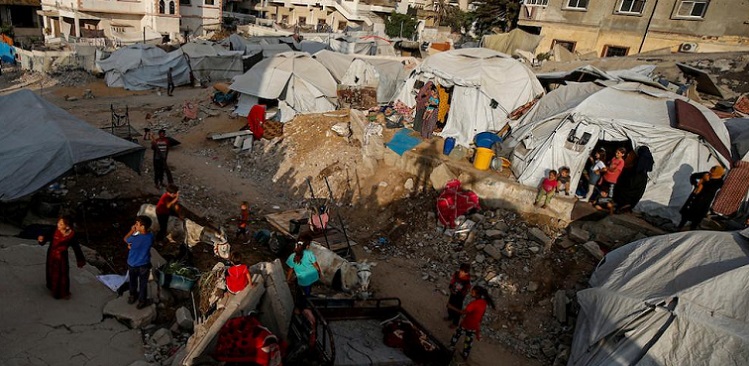
This report is the third on the results of the ninth Arab Barometer (AB9) survey in Palestine. This summary covers findings related to the prevailing conditions in the immediate aftermath of the October 2025 ceasefire, including access to essential services, food security and access to aid, displacement, public priorities, recovery and reconstruction, and emigration. AB9 was conducted by the institute for Polling and Survey Research West Bank and Gaza Strip during 8–26 October 2025. But most of the questions covered in this report were specifically asked in the Gaza Strip.
The period preceding the survey witnessed several important developments, including the continuation of the war on the Gaza Strip until a ceasefire was reached two days after fieldwork began. In the West Bank, settler violence and terror continued against vulnerable, unprotected Palestinian towns without intervention by either the Palestinian or Israeli police to stop these assaults—indeed with complicity and even encouragement in some cases from the Israeli government and with the army providing protection to settlers only. The Israeli army enforced closures on Palestinian areas and restricted Palestinians’ access to main roads in the West Bank.
The ceasefire in the Gaza Strip came as part of what is known as the 20‑point Trump Plan, which made no reference to the situation in the West Bank. The period before fieldwork also saw a sharp decline in government services due to Israeli punitive measures against the Palestinian Authority (PA), including the seizure of clearance revenues, which forced the PA to pay only a portion of public‑sector salaries and curtailed its ability to provide many basic services. Israel also imposed stringent conditions, demanding “reforms” rejected by Palestinian public opinion—such as amending school curricula and halting payments to the families of prisoners and martyrs.
Methodology: |
Interviews for AB9 were conducted face‑to‑face between 8 and 26 October 2025 with a random sample of 1,655 adults across 160 residential localities in the West Bank, Gaza Strip, and Jerusalem. The sample size was 855 in the Gaza Strip and 800 in the West Bank, in 80 locations in each; the margin of error was ±3%. All West Bank interviews were conducted in “counting areas,” as defined by the Palestinian Central Bureau of Statistics. In the Gaza Strip, interviews were held in 33 counting areas; the remainder were conducted in a representative sample of shelters, built-up and tent shelters, selected by systematic random selection, with quotas to represent areas destroyed by the war or those that were not safely accessible because they were under Israeli military occupation. PCPSR issued in January 2026 the first report on AB9, covering issues of governance and the domestic balance of power, which can be accessed here: ARAB BAROMETER 9 in Palestine | PCPSR |
Summary of Findings: |
Palestinian Public Opinion Before and After October 7: Conditions in the Gaza Strip |
The findings of AB9 paint a picture of severe and multidimensional humanitarian distress in the Gaza Strip. Access to basic services remains critically limited, with water being the only utility available to a majority of residents, while access to electricity, fuel, and sanitation infrastructure remains extremely scarce. Nearly one-fifth of respondents reported having no access to any of the essential utilities measured.
Food insecurity remains widespread. More than half of respondents experienced periods without food during the previous week, while many households reduced the number of daily meals consumed. Access to drinking water is similarly precarious. The principal barriers to obtaining food are shortages of supplies and lack of purchasing power, compounded by logistical and security challenges.
Although most households receive some form of humanitarian assistance, aid delivery is largely irregular and insufficient. Respondents identified shortages, insecurity, long queues, and transportation difficulties as major obstacles to accessing aid.
The war has had devastating economic consequences. Large majorities reported losing income and employment. Health care needs remain substantial, with most households requiring medical attention since the start of the war and many unable to obtain adequate treatment. The conflict has also produced significant human losses, with nearly one-third reporting the death of a household member and over two-fifths reporting injuries or disabilities.
Education has been severely disrupted. While some children continue to access learning opportunities through humanitarian organizations, online platforms, or home schooling, many remain excluded from education. Nearly half of households reported interruptions to higher education.
When asked about the agencies that oversee the delivery of aid in their locations of residence or shelter, the largest percentage of respondents indicated that it was UNRWA, a third said it was another international agency, a fifth said it was a local Palestinian group and the rest said it was the government.
Displacement has been nearly universal, with most displaced respondents experiencing multiple episodes of displacement. The conflict is overwhelmingly perceived through the lens of mass violence, with "genocide" emerging as the most common characterization.
Looking ahead, respondents prioritize shelter, food, employment, and water. Reconstruction of housing and infrastructure is viewed as the most urgent recovery need, and there is strong support for a large-scale Arab-led reconstruction initiative. Despite the hardships, a majority indicate that they would choose to remain in Gaza rather than leave if given the opportunity.
(1) Conditions in the Gaza Strip |
Access to Basic Utilities and Services: Respondents in the Gaza Strip were asked whether five essential utilities and services were available in the place where they currently reside: water, electricity, fuel or gas, indoor plumbing, and internet/mobile phone connectivity. Access to water was reported by 76% of respondents, making it the most widely available service. This was followed by internet or mobile phone connectivity (45%), indoor plumbing (22%), electricity (9%), and fuel or cooking gas (6%). Notably, 18% reported having no access to any of these essential utilities or services.
Figure (1): Available amenities in place where you now live

Food and Water Security: When Gazans were asked about access to food during the previous seven days, 47% reported having food every day. However, 30% said they had gone without food on some days, 17% had not eaten during most of the previous seven days, and 5% reported having gone without food throughout the entire seven-day period.
Figure (2): In the past 7 days, you went days without eating

It is worth noting that access to food gradually became easier once the ceasefire went into effect, particularly by the last two days of data collection, which coincided with the sixth and seventh day of the ceasefire. For example, while the percentage of those indicating that they have eaten in all the previous 7 days stood at 37% on the eve of the ceasefire, it reached 59%, on daily average, by the 6th and 7th days (the last two days of data collection were combined to ensure a relatively large sample size). Similarly, while on the eve of the ceasefire, 8% indicated that they did not eat during any of the previous 7 days, that daily average dropped to 2% on the last two days of the ceasefire.
Figure (3): In the past 7 days, you went days without eating

Only one-third of respondents indicated that they had not needed to reduce the number of daily meals consumed by their household. In contrast, 38% reported reducing meals on most days, while 30% did so on some days.
Access to drinking water was similarly limited. While 38% reported daily access to drinking water, 26% indicated that they lacked access on most days, and 36% lacked access on some days.
Respondents were also asked about the challenges their households face in obtaining food. Half cited the absence of food or insufficient quantities in markets and stores, while an equal proportion reported a lack of financial resources to purchase food. Nearly half (47%) pointed to shortages in warehouses and supply centers. Other challenges included long queues at food distribution sites (29%), violence or insecurity preventing access to food distribution centers (24%), the absence of nearby distribution centers (20%), lack of transportation (11%), insecurity or violence around distribution centers (11%), and inappropriate behavior by aid workers (11%). Only 2% reported facing no significant challenges in obtaining food.
Figure (4): challenges your household face while trying to acquire food

Access to Humanitarian Assistance: The survey examined access to humanitarian assistance and the types of aid received. Among those receiving aid as their main source of material support, food and water assistance was the most commonly received form of aid (76%), followed by cash assistance (51%). Smaller percentages reported receiving housing assistance (17%), household items such as blankets and cooking utensils (16%), clothing and shoes (14%), other non-food items (13%), medical assistance (6%), and fuel assistance (2%).
Figure (5): Types of aid received

Only 18% of those whose main source of material support was aid reported receiving assistance on a regular basis, while 81% indicated that aid was received irregularly.
Respondents were also asked about challenges encountered while attempting to access humanitarian aid. The most frequently cited obstacle was the insufficiency of available supplies (57%). Other major challenges included long waiting lines at distribution sites (39%), insecurity or violence around aid distribution points (33%), the absence of nearby distribution centers (32%), lack of transportation (21%), movement restrictions and other barriers to access (18%), and inappropriate behavior by aid workers (15%).
Figure (6): Challenges faced when seeking aid

Impact of the War on Livelihoods: Respondents were asked about the impact of the war that began on 7 October 2023 on their household's income and employment. A substantial majority (69%) reported experiencing a loss of income, while 62% indicated that they or members of their household had lost employment as a result of the war.
Figure (7): Impact of the war on income and job

Access to Health Care: Nearly two-thirds of respondents (63%) reported that they or a member of their household had required medical attention since the beginning of the war, while 37% reported no need for medical care. Among those requiring treatment, 51% said the need was primarily related to war injuries or war-related conditions, 39% cited chronic illnesses, and 37% referred to acute medical conditions. When asked whether the health conditions requiring treatment had emerged before or after the outbreak of the war, 41% reported that the condition developed after 7 October 2023, 37% said that some conditions began before and others after the war, and 22% indicated that the condition predated the conflict.
Regarding access to treatment, 32% reported that all household members requiring care were able to receive it, while 51% said that only some were able to obtain the treatment they needed. Eighteen percent stated that none of those requiring treatment were able to access needed medical care.
The survey also examined the human toll of the conflict. Thirty percent of respondents reported the death of at least one family member who had lived in their household before 7 October 2023, while 70% reported no such loss. Furthermore, 41% reported that a household member had experienced injury or disability since the beginning of the war.
Figure (8): Experienced death or injury in the household

Access to Education: Sixty-nine percent of respondents reported having school-aged children (6–18 years old) in their household. Among these households, 24% indicated that all school-aged children were currently accessing some form of education, while 43% said that only some children were doing so. Nearly one-third (31%) reported that none of their children had access to education during the current school year.
Figure (9): Access to education

Amng those with access to education, the most common forms were educational initiatives provided by the United Nations or similar organizations (55%), online schooling (52%), home schooling (32%), private schools (16%), and public schools (6%).
Figure (10): Access to types of education

The survey also assessed disruptions to higher education. Nearly half (49%) reported that at least one household member had experienced an interruption in university or college education due to the war. Among those affected, 44% reported being able to resume their studies, while 54% remained unable to do so.
Agencies supervising the provision of aid: from among four possible groups supervising the provision of aid in your location of their residence or refuge, the largest percentage of respondents, 38%, indicated that it is UNRWA, one third said it is another international agency, 20% said it is a local Palestinian group, and 8% said it is the government.
Figure (11): Main agency supervising aid provision where you are located

(2) Basic needs, Coping Strategies, and Priorities in the Gaza Strip: |
Basic Living Needs: Respondents in the Gaza Strip were asked whether their households' basic living needs were currently being met. Nearly three-quarters (74%) reported that these needs were mostly unmet, while only 26% indicated that they were mostly met.
Figure (12): Household basic needs are

To cope with these hardships, respondents reported adopting various strategies. Nearly half (48%) reduced other household expenditures, 43% relied on savings, and 42% received financial assistance or remittances from relatives and friends. Other coping mechanisms included reducing food consumption (35%), relying on humanitarian aid (34%), borrowing money (32%), sharing housing arrangements (11%), sending children under the age of 16 to work for pay (10%), and reducing the use of medical care (6%).
Figure (13): Strategies adopted to overcome challenges in providing for your basic living needs

Top Priorities: When Gazans asked to identify the most urgent priorities facing their households, adequate housing or shelter ranked first, cited by 78% of respondents. Food was mentioned by 69%, followed by employment and income generation (40%), water (35%), education (23%), personal protection and safety (20%), access to medication (17%), and mobility (6%).
Figure (14): Top priorities for Gazans now

(3) Displacement and Perceptions of the War: |
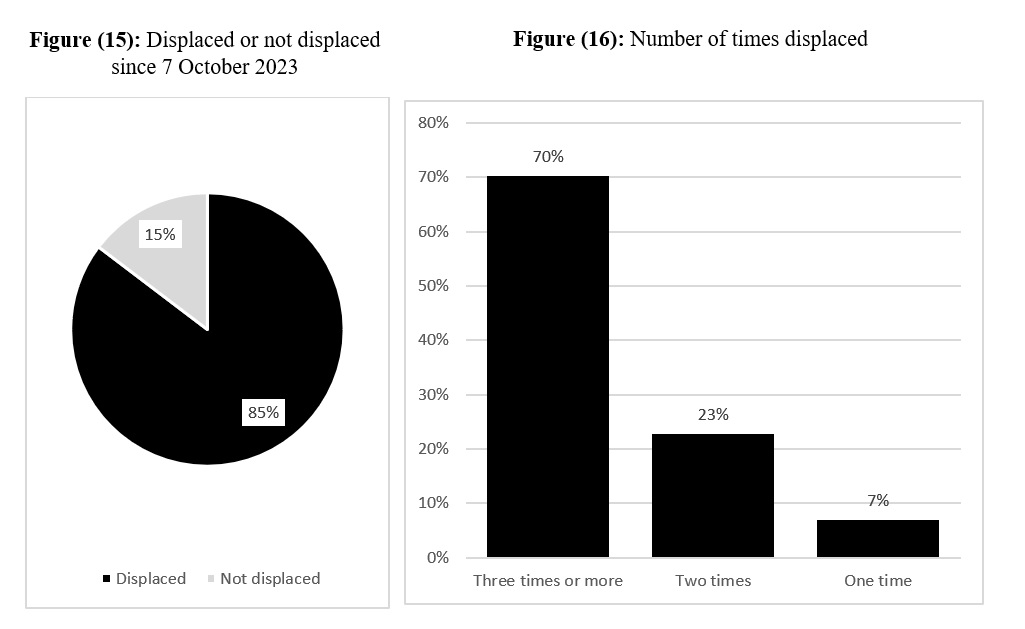
Displacement: The overwhelming majority of Gazan respondents (85%) reported having been displaced at least once since the start of the war. Among those displaced, 70% had experienced displacement three or more times, 23% had been displaced twice, and 7% had been displaced once.
Characterization of the War: Respondents in both the Gaza Strip and the West Bank were asked how they would characterize the Gaza war. The largest proportion described it as a genocide (49% overall, including 61% in the West Bank and 33% in the Gaza Strip). This was followed by ethnic cleansing (14%), massacre (13%), war (5%), mass killing (6%), hostilities (1%), and conflict (1%). Eleven percent described it as “all of the above.”
Figure (17): Term best describes the latest events in Gaza

(4) Recovery and reconstruction in the Gaza Strip: |
Priority Needs for Recovery: Respondents in the Gaza Strip were asked to identify the two most important priorities for rebuilding and recovery in their communities. Rebuilding and repairing homes and infrastructure emerged as the leading priority, selected by 41% of respondents. This was followed by job creation and economic recovery programs (16%), access to humanitarian aid (15%), justice and accountability for crimes and violations suffered during the war (11%), education for children and youth (10%), and mental health and psychosocial support programs (7%).
Figure (18): Most important recovery need

Preferred International Role in Gaza: Respondents in the Gaza Strip were asked about the role they would like the international community to play in Gaza's future. The most frequently selected option was providing material support for reconstruction (44%). This was followed by providing emergency humanitarian assistance (24%), facilitating safe passage and asylum opportunities in European countries (12%), deploying an international peacekeeping force (10%), and facilitating safe passage and asylum opportunities in Arab countries (6%). Four percent indicated that they did not want the international community to play any role in Gaza.
Figure (19): What role for the international community?

Support for the Arab Reconstruction Plan: Respondents in both the Gaza Strip and the West Bank were asked whether they supported the Arab plan for Gaza's reconstruction. The plan was described as including a $53 billion reconstruction fund financed by Arab countries, governance by a technocratic administration, and the deployment of United Nations peacekeeping forces in Gaza and the West Bank. A large majority (74%) expressed support for the proposal. Support was considerably higher in the Gaza Strip (85%) than in the West Bank (66%).
Figure (20): Attitudes regarding the Arab Plan

(5) Leaving Gaza now: |
When asked whether they and members of their household would leave Gaza immediately if given the opportunity, a majority (54%) said that neither they nor other household members would leave. One-third (33%) said that both they and their household would leave. An additional 6% indicated that only other household members would leave, while 7% said that only they themselves would leave.
Figure (21): If given the opportunity, would you and members of your household leave Gaza right now?
